Sleep science and sleep health
How to Choose a Body Pillow for Comfortable Spinal Alignment
A body pillow can make a familiar sleeping position feel steadier, especially for people who sleep on their sides. But comfort does not come from size alone. The right pillow should fit your body and sleep habits without pushing your neck, hips, or knees into an awkward position.
Published November 1, 2026
A body pillow is an uncomplicated object with a surprisingly personal job. It may rest between the knees, support an arm, follow the length of the torso, or simply give a sleeper something to hold. These uses can make it easier to settle into a comfortable posture. Yet no pillow can guarantee perfect spinal alignment, cure pain, or replace medical care. Its value is more modest—and often more useful: a well-chosen pillow can help a sleeper maintain a position that feels relaxed and sustainable through the night.
Choosing one means looking beyond labels such as “orthopedic” or “full-body support.” Length, loft, firmness, fill, cover, and ease of care all shape how a pillow behaves. So does the person using it: shoulder width, body proportions, mattress feel, preferred sleep position, and whether the sleeper changes positions all matter. The best choice is not the most elaborate one. It is the pillow that supports without forcing.
What spinal alignment means in bed
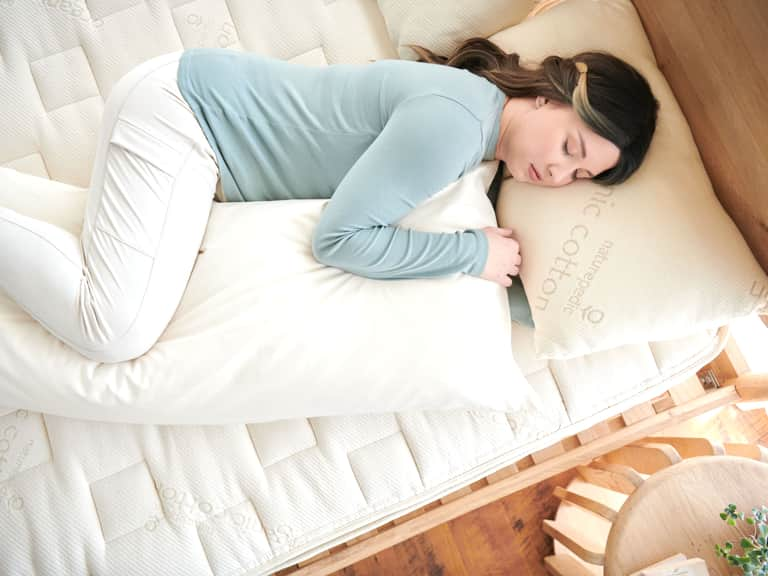
The spine has natural curves. During sleep, comfortable alignment does not require making the body rigid or perfectly straight; it means avoiding a position that leaves the neck or trunk bent, twisted, or strained for long periods. A side sleeper, for example, may feel more comfortable when the head, shoulders, and torso remain in a relatively continuous line, rather than allowing the head to tip sharply toward the mattress or ceiling.
At the hips and legs, the same principle is practical rather than mathematical. If the upper leg falls far forward across the body, the pelvis may rotate. If the knees press together, some sleepers notice tension. Placing a pillow between the thighs or knees can create a more comfortable buffer and help the legs rest in a position that feels less twisted. The effect varies from person to person, and a pillow’s presence does not prove that the spine is clinically aligned.
Back sleepers may use a body pillow differently: along one side for a light arm rest, beneath the knees if that feels comfortable, or not at all. Stomach sleepers often need to be especially attentive to neck turning and pillow bulk, since the position itself can place the neck in rotation. A large pillow may be reassuring to one sleeper and cumbersome to another. The body’s response is more informative than a one-size-fits-all rule.
Start with sleep position, not product claims
Before comparing materials, notice how you actually sleep. People often begin the night in one position and wake in another. A useful body pillow should accommodate that reality, rather than requiring the sleeper to remain carefully arranged. Consider whether you tend to sleep on your side, back, or stomach; whether you switch sides; and whether your arms or legs need extra room.
- Side sleepers: A pillow positioned between the knees or thighs may reduce the feeling of the upper leg dropping forward. A longer pillow can also support the arms and torso, if that feels natural.
- Back sleepers: A full-length pillow may be more than needed. Some people prefer a smaller cushion near the knees or a body pillow beside them, while others find either distracting.
- Stomach sleepers: A bulky pillow may crowd the arms or encourage an uncomfortable neck angle. If you try one, keep the setup low and simple, and pay attention to whether your neck feels strained.
- Combination sleepers: Choose a shape that can move easily as you turn. A pillow that is difficult to reposition may end up on the floor rather than supporting you.
These are starting points, not prescriptions. A position that feels comfortable for one person may not work for another, even if they sleep on the same side. Pregnancy, injuries, chronic pain, breathing problems, and other health circumstances can also change what feels appropriate. When a positioning question relates to a medical condition, advice from a qualified clinician is more dependable than a general pillow guide.
Length and shape: enough support, not a barrier
Body pillows come in different lengths and shapes. A long, straight pillow may serve several purposes: supporting an arm, giving the legs something to rest against, or offering a soft boundary along the torso. A shorter pillow can be easier to manage and may work well when the main goal is support between the knees. Contoured or curved designs may keep a particular area in place, but their shape can also make them less versatile.
Think about the bed as well as the body. A pillow that occupies most of the available space can make turning difficult, particularly in a shared bed. It may bunch beneath the covers, interfere with a regular head pillow, or take up room needed for a partner. Measure the space you have and consider where the pillow will go when you are not using it. Convenience is part of comfort; a support that is awkward to handle may not become part of a lasting routine.
Length also affects how a pillow can be used. A longer model allows a sleeper to hug one section while resting a leg against another. A shorter one may be easier to shift between the knees and torso. There is no universal ideal. The useful question is whether the pillow reaches the areas you want to support without bunching or forcing you to hold an unnatural pose.
Loft and firmness: the fine line between support and pressure
Loft describes a pillow’s height or thickness. For a body pillow, loft is not only about what sits beneath the head; it also affects how far the knees separate, how high an arm is lifted, and whether the torso is pushed away from the mattress. A pillow that is too thick between the legs may spread the hips uncomfortably. One that compresses almost flat may not provide the cushion a sleeper is seeking.
Firmness is related but distinct. A firm fill may hold its shape and provide a more stable surface; a softer one may feel yielding and easier to hug. If the pillow is very firm, it can create pressure where the body rests against it. If it is too soft for your preference, it may collapse or shift. Neither quality is inherently superior. The right balance depends on the sleeper’s body, mattress, and intended use.
Try to assess the pillow in the position in which you expect to sleep. A quick squeeze in a showroom or a description on a label cannot fully show how it behaves between the knees or beneath an arm. If possible, check the return or trial terms before buying, since a pillow’s true fit becomes clear over repeated nights, not a few seconds of handling.
Fill materials and what they change
Fill influences how a pillow responds to pressure, how much it shifts, and how readily it can be adjusted. Common options include polyester fiber, down or feather blends, foam, and latex. Each has trade-offs. Fiber fills can feel soft and familiar but may flatten or clump over time. Foam may contour closely, though some sleepers find it warm or difficult to reshape. Latex can feel resilient and springy, while feather or down blends tend to be compressible and easy to mold, depending on their construction.
Some body pillows have adjustable fill, allowing the sleeper to remove or add material. This can be useful when the initial loft is too high or too low, and it allows the pillow to evolve with changing preferences. It also means taking time to make small adjustments and keeping any removed fill in a clean, dry place. A zipper alone does not guarantee easy customization: check whether the opening is manageable and whether spare fill or replacement components are available.
Material choice can also involve sensitivities, warmth, care instructions, and personal values. Read the product’s material details rather than relying on broad phrases such as “natural” or “hypoallergenic.” Such terms do not mean that every person will tolerate a material or that the pillow is appropriate for a specific health concern. If you have a known allergy or sensitivity, verify the relevant components—including the cover, fill, and any treatments—with the maker or a clinician as needed.
One example of a materials-focused option is the Naturepedic Body Pillow. Its listed construction includes an organic cotton sateen cover and shredded organic latex fill, and its stated dimensions are 24 by 54 inches. That combination may appeal to sleepers looking for a resilient, moldable fill and a cotton cover. As with any pillow, the description cannot establish personal comfort or guarantee relief; fit should be judged by how it feels in the position you use.
How to position a body pillow
Positioning is a small experiment. Begin with the least complicated arrangement that addresses the discomfort or instability you notice. If you sleep on your side and want to reduce the upper leg’s tendency to roll forward, place a pillow between the knees or thighs. Let the legs rest naturally; do not force them wide apart. If the pillow is long enough, you may hug the upper portion while keeping the lower portion between the legs.
Keep your head on your usual head pillow unless you are deliberately reassessing it. A body pillow is not automatically a replacement for a head pillow, and changing both at once can make it difficult to identify what feels better. Check that your head is not being pushed upward or tilted sideways by the body pillow’s position. The neck should feel relaxed, not propped into a sharp angle.
For back sleeping, try a body pillow beside the torso or a smaller support beneath the knees only if it feels comfortable. Avoid using a bulky pillow to hold the body in a position that feels restrictive. For stomach sleeping, a full-length pillow may be unnecessary; consider whether its height changes the position of your shoulder, face, or neck. Comfort that depends on bracing or persistent muscular effort is a sign to adjust the setup.
After positioning the pillow, take a moment to notice pressure and ease of movement. Can you breathe comfortably? Can you relax your shoulders? Does the pelvis feel level, or does the pillow twist the legs? Can you turn without wrestling with the cushion? These are useful everyday checks—not diagnostic tests. If the arrangement creates numbness, tingling, worsening pain, or other concerning symptoms, stop using it and seek appropriate professional guidance.
Covers, cleaning, and everyday usability
A pillow is used close to the body, so its cover and care requirements deserve attention. A removable, washable cover can simplify routine cleaning, while a protective pillowcase may reduce direct wear on the fabric. Check the care label before washing: some fills require spot cleaning or air drying, while others can tolerate machine washing. Washing a pillow contrary to its instructions may damage its shape, seams, or filling.
Breathability is another personal consideration. A thick cover or dense fill may feel warm to some sleepers, while others prefer the sense of enclosure. Cotton, linen, and synthetic fabrics all vary by weave and construction; the fiber name alone cannot predict how cool a product will feel. If you tend to overheat, prioritize a cover that is comfortable against your skin and a fill that does not feel excessively warm in your room.
Consider the practical details before making a choice: Is a pillowcase available in the correct size? Can the pillow be stored without folding it sharply? Will the cover remain secure as you move? Is the fill likely to need regular fluffing? These questions may sound mundane, but they help distinguish a pillow that works in daily life from one that looks promising only in a product description.
A short, low-pressure trial
Rather than overhaul your sleep setup, test one change at a time. Use the pillow for several nights in a consistent position, then adjust its placement or loft in small increments. Keep a brief note of what you notice when you wake: comfort, ease of turning, pressure at the hips or shoulders, and whether the pillow stayed in place. A record can reveal patterns that a single good or bad night cannot.
- Identify the goal. Decide whether you want a cushion between the knees, support for the arms, or a body-length object to hug.
- Choose a manageable size. Make sure the pillow fits your bed and does not prevent natural movement.
- Try the simplest position. Begin with a light, comfortable placement rather than tightly wedging the pillow into place.
- Adjust gradually. Change loft or location one step at a time, especially if the pillow has removable fill.
- Stop if discomfort increases. A pillow should not require you to tolerate new pain, numbness, or strain.
Sleep is affected by many things beyond bedding, including stress, schedules, health, room conditions, and sleep disorders. A body pillow can be one practical part of a comfortable environment, but it is not a treatment for persistent symptoms. Ongoing pain, significant sleep disruption, or breathing concerns deserve attention from a qualified health professional, particularly when symptoms are new, severe, or worsening.
The right fit is the one that lets the body settle
Choosing a body pillow is less about discovering a universally correct model than about noticing what your body finds easy to maintain. Length determines where support can reach; loft and firmness influence how much the pillow separates or cushions the body; fill shapes its resilience and adjustability. Sleep position points toward useful starting arrangements, but it does not dictate a single answer.
Look for support that feels present but not intrusive. A pillow should not force the knees apart, lever the shoulder upward, twist the pelvis, or lock you into a posture. If it helps you settle, move freely, and wake without new discomfort, it may be a worthwhile addition. If it becomes an obstacle, the simplest solution may be a smaller pillow, a different position, or no body pillow at all.
The goal is not a perfect line drawn through the sleeping body. It is a night spent with less unnecessary strain and enough room to rest naturally. Start with your own habits, make modest changes, and let comfort—not a slogan—decide whether the pillow belongs in your bed.